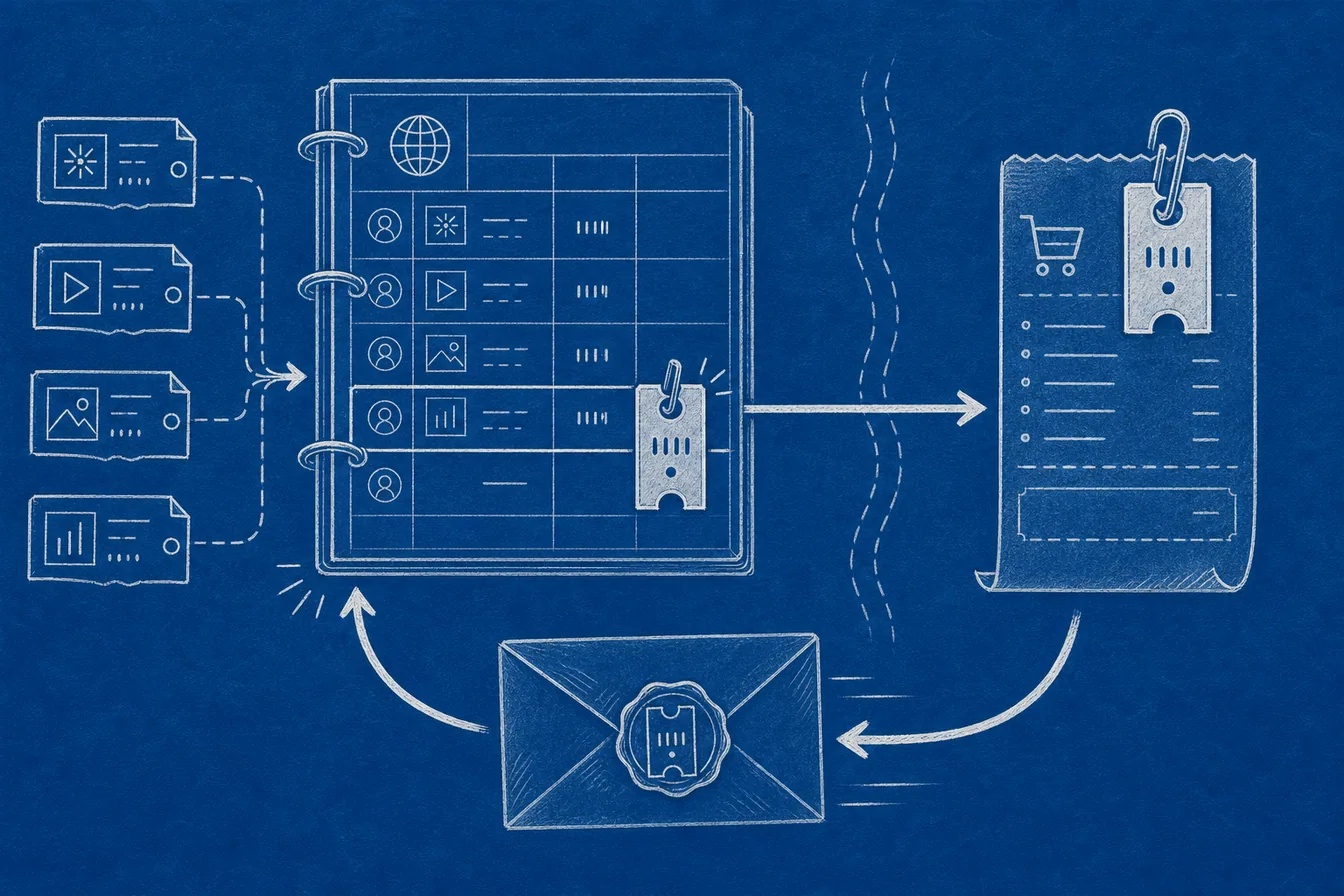
A hosted checkout breaks conversion attribution when the ad click lives in a browser session on your landing-page domain and the confirmed purchase returns later from a different domain as a webhook. The payment is real, but the webhook has no cookie jar, landing URL, or click parameters. Without a shared reference, your server cannot tell which browser record belongs to that order.
The fix is a first-party attribution index. Capture the eligible click IDs and session context before the visitor leaves the landing page, save them under a short opaque index ID, and pass only that ID into the checkout. When the paid webhook arrives, read the same ID from the order and load the original browser record. The index ID is the join. It is not another ad-platform click ID.
This is the question I hear most often when a tracking build works on the landing page but purchase match quality drops at the payment boundary. The missing piece usually sits between those two systems.
What should the hosted checkout tracking flow preserve?
Preserve the information that can reconnect the paid order with its eligible ad session, while keeping the checkout reference small. The record usually contains the platform click IDs collected on the landing page, readable campaign parameters, first-party browser identifiers, the consent state that applied at collection time, and timestamps. The checkout receives one random internal reference. It does not need the full record. When the provider confirms payment, the webhook handler uses that reference to fetch the record and build a separate conversion payload for each destination. Keep the order ID beside it for deduplication, but do not confuse the two jobs. The attribution index finds the browser session. The order ID identifies the business transaction. One visit may produce more than one order, while a single order may cause repeated webhook deliveries.
| Object | Created where | What it does | Needed at webhook time |
|---|---|---|---|
| Platform click ID | Landing URL or platform cookie | Links the conversion to an eligible ad click | Yes, when the destination accepts it |
| Attribution index ID | First-party endpoint | Points to the stored browser record | Yes |
| Checkout Session ID | Payment system | Identifies the payment attempt | Yes for retrieval and reconciliation |
| Order ID | Your commerce system | Identifies the transaction and controls duplicate counting | Yes |
Why does attribution fail across a hosted checkout domain?
The domain change splits one customer journey into two technical contexts. On the landing page, the browser can expose URL parameters such as a Google click ID or oppref, plus first-party cookies written by your tags. On the hosted payment page, your normal web container may no longer run, and your first-party cookies are not available to that other site. Hours later, the webhook comes from the payment provider’s server. It knows the Checkout Session and payment status. It does not know the browser tab that started the purchase unless you gave the checkout a reference to it. A success-page redirect cannot repair that history. Some buyers close the tab, lose connection, or finish a delayed payment without loading the return page. Stripe’s fulfillment guidance therefore requires a webhook path for reliable fulfillment and warns that the handler can run more than once.
This creates a clean diagnosis: if the paid order has no reference to the stored landing-page record, the attribution break happened before the webhook.
What is a first-party click ID index?
A first-party click ID index is a server-side lookup table that maps one opaque internal ID to the advertising context collected on your own landing page. Think of it as a claim ticket. The ticket crosses the checkout boundary; the valuable details stay in your storage. The stored row can include gclid, gbraid, wbraid, fbclid, fbc, fbp, ttclid, oppref, GA4 client and session context, UTMs, entry page, timestamps, and the consent state that governed collection. Only store fields you are allowed and need to use. The internal ID should be random enough to resist guessing, free of personal data, and short enough for the checkout field that carries it. Set a retention period that matches the business and platform use, then delete stale records. First-party describes who controls the record and where it was collected. It does not create an exemption from consent, notice, security, or deletion duties.
The first-party and third-party cookie guide explains the browser side. The index is the durable server record that survives after the browser disappears.
How do you carry the index through a hosted checkout?
Create the index before redirecting. The landing page sends the permitted attribution context to a first-party endpoint, which writes the row and returns the opaque index ID. Only after that write succeeds should the checkout action use the ID. An API-created Checkout Session can place it in a documented reconciliation field or session metadata. Stripe defines client_reference_id as a unique string that can reconcile the Session with an internal system. For a hosted Stripe flow, that is a natural place for the attribution index ID. Other payment systems expose different fields, so treat each integration as an adapter with a tested input and webhook output. Never guess a field name from another checkout. The paid event must return the same bytes you stored, or let your handler retrieve the Checkout Session that contains them.
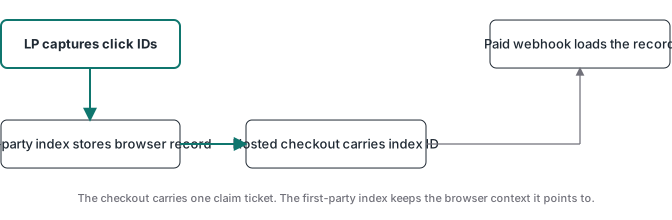
A reliable sequence looks like this:
- Read eligible click IDs and campaign parameters on the landing page.
- Apply the project’s consent rule before saving advertising data.
- Persist the browser context under a random attribution index ID.
- Create or open checkout with that index ID in its supported reference field.
- Verify the payment webhook and confirm the paid state.
- Load the index row, then create destination-specific conversion events.
- Use the order ID and provider event ID to make retries safe.
The Stripe conversion tracking guide covers payment states, delayed methods, signature checks, and destination fan-out in detail.
Why does match quality fall when the join is missing?
The purchase webhook may still contain an email, phone number, value, and currency, depending on the checkout and your permitted use. That can be enough for a destination to receive a Purchase event. It is weaker than the browser record you had before redirecting. The lost row may contain the click ID that proves which ad earned the order, first-party browser identifiers used for account matching, the original session context, and the consent state tied to collection. Meta’s Event Match Quality assesses the customer information available on eligible website events, while Google’s offline click conversion path associates a conversion with one of its accepted click identifiers. Google’s current offline conversion sample also carries conversion time, value, currency, order ID, and consent. Those fields do different jobs. The order ID stops one transaction from becoming two. The click ID connects that transaction to an ad interaction.
This is why a working webhook can coexist with weak campaign reporting. Transport succeeded. The identity and attribution join did not.
For the platform-specific matching surface, see the Facebook Conversions API guide. For ChatGPT Ads, the same architecture preserves oppref until the server conversion is ready.
How should the webhook rejoin the browser session?
Verify the webhook before trusting any order data. For Stripe, signature verification uses the raw request body, the Stripe-Signature header, and the endpoint secret, as documented in its webhook signature guide. After verification, retrieve the canonical Checkout Session when needed and confirm the payment state. Read the attribution index ID from the tested reference field, then request that exact row from your first-party store. An absent ID, expired row, or consent state that blocks advertising use should produce an explicit unattributed result. Do not borrow the last click seen for the same email, match on a partial token, or silently fall back to a campaign. Those shortcuts make dashboards look fuller by assigning revenue without evidence. Log the order ID and reason instead. You can reconcile it later if a valid record appears through a documented recovery path.
Once the row is valid, map it into each destination’s contract. Share the business transaction ID, value, currency, and paid time. Keep platform click IDs and browser identifiers in the payloads that accept them.
What should you test before publishing the setup?
Test the join as a sequence, not as separate green dashboards. Start one controlled visit with known test parameters and record the attribution index ID returned by your first-party endpoint. Confirm the exact ID enters the Checkout Session. Complete a real test payment, inspect the signed webhook delivery, and prove that the handler loads the expected browser row. Then inspect each destination for event receipt, click attribution where reporting exposes it, and duplicate handling. Check that the provider event ID and order ID are recorded under separate uniqueness rules, since webhook retries and repeat purchases are different cases. A successful endpoint response proves that your server received a request. It does not prove that the payment was eligible, the index resolved, or the campaign received credit. Keep one test receipt with timestamps and IDs so a later regression can be compared against a known path.
Run negative controls too:
- Send a valid paid webhook with no attribution index and confirm it enters an unattributed queue.
- Change one character in the index ID and confirm the lookup fails closed.
- Replay the same webhook and confirm the purchase is not counted again.
- Use two orders from one indexed visit and confirm both remain distinct transactions.
- Let a test record expire and confirm the handler reports expiration instead of guessing.
Where does server-side GTM fit?
Server-side GTM receives the verified purchase, loads or receives the indexed context, and turns one paid order into the payload each measurement platform expects. It is the routing and transformation layer. Durable attribution storage still belongs in a database or another store designed for lookups and retention. A container variable is not a ledger. A cookie is not available to the webhook. The server container also needs a clear failure branch for an index that is absent, expired, or blocked by the recorded consent state. Sending a thinner event may be valid for one destination; assigning an unsupported click ID is not. The architecture needs all three pieces: first-party capture on the landing page, an index reference that survives hosted checkout, and an authenticated webhook workflow that rejoins the record before sending conversions.
If you build this repeatedly for client funnels, Advanced Tracking Academy for media buyers includes maintained server-side GTM containers for supported checkout and ad-platform combinations. The Stripe build captures attribution before checkout, validates the payment webhook, applies paid-state and duplicate controls, and sends destination-specific events. Import it, configure the account fields, and test the real boundary in under an hour.
The webhook proves the purchase. The first-party index remembers where it came from. Keep those roles separate, then join them on a reference both systems can return.