
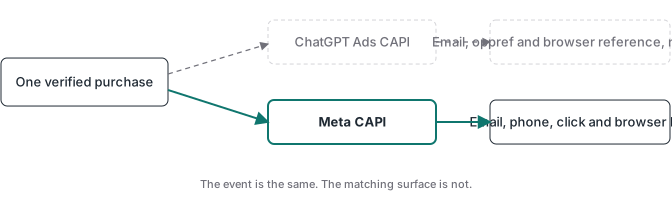
ChatGPT Ads and Meta CAPI solve the same delivery problem with different measurement surfaces. Both can receive a conversion from your server, pair it with a browser event, and deduplicate the two copies. Meta has a broader matching vocabulary and a mature global media footprint. OpenAI’s current API omits phone numbers, rejects events older than seven days, and supports ad buying in a much smaller set of countries.
That makes this less of a feature contest and more of a data-contract decision. If you already send verified purchases to Meta, most of the underlying event work can be reused for ChatGPT Ads. The payload cannot. Treating one API as a renamed version of the other creates quiet attribution gaps, especially for phone-first leads and delayed offline conversions.
Are ChatGPT Ads and Meta CAPI the same kind of system?
They have the same basic shape. A browser tag captures page and click context, while a server API sends events from infrastructure you control. When both routes report the same purchase, a shared event identifier lets the destination keep one conversion. Both systems can use customer information to connect a server event with an eligible ad interaction. That is where the similarity ends. OpenAI uses its own Pixel ID, conversion credential, oppref click reference, obref browser reference, supported event names, and user object. Meta CAPI uses a dataset or Pixel ID, its own access token, Meta click and browser identifiers, and a larger customer-information map. One verified purchase can feed both, but each destination needs a separately built payload. A clean implementation shares the source event and consent decision, then branches at the last responsible moment.
| Measurement surface | ChatGPT Ads | Meta CAPI |
|---|---|---|
| Browser route | OpenAI Pixel | Meta Pixel |
| Server route | OpenAI Conversions API | Meta Conversions API |
| Ad click context | oppref | Meta click context carried in fbc |
| Browser reference | obref from __obref | fbp |
| Hashed email | Supported | Supported |
| Hashed phone | Rejected | Supported when collected and sent lawfully |
| Shared deduplication value | API id and Pixel event_id | Matching event_id and event name |
| Old server event | Rejected after seven days | Follow the current rule for the event source and API version |
| Advertiser geography | Limited beta list, with no EU country currently listed | Broad global ad market |
The table describes capability, not permission. A field being accepted by an API does not mean you may collect or send it in every situation.
Which matching fields does each API accept?
OpenAI’s current user object accepts obref, email_sha256, external_id_sha256, country, city, postal code, IP address, and user agent. Its Conversions API documentation explicitly says not to send raw email, raw external IDs, phone numbers, or phone-number hashes. The hashed fields must be lowercase 64-character SHA-256 strings. Meta CAPI accepts a wider set of customer information, including normalized and hashed email and phone, name and address fields, an external ID, plus click, browser, IP, and user-agent context. That extra surface can matter when a record has a phone number but no email. It does not turn a weak event into a true one. Both platforms still receive whatever your system declares. Use a payment webhook or a verified CRM state as the source, then attach only the matching data you collected with the required notice and permission.
What does OpenAI’s seven-day window actually mean?
The seven-day rule is about event acceptance. It is not the campaign’s attribution window. OpenAI requires timestamp_ms to fall within the previous seven days and no more than ten minutes ahead of receipt. A batch sent on Monday can include an event from the prior Tuesday, but an older event is outside the API contract. This matters for offline imports, CRM qualification, subscription events, and retry queues. If a nightly job fails for eight days, replaying the backlog will not rescue the oldest ChatGPT Ads events. Run the sender frequently, alert on rejected batches, and keep a dead-letter record with the response. Meta also has timing rules that vary by event source and API contract, so prompt delivery is good practice there too. The operational mistake is copying a monthly offline-upload habit into a channel with a documented seven-day ceiling.
There is a second clock. OpenAI evaluates an accepted event against the attribution window configured for the campaign. An event can satisfy one clock and miss the other. Store both the real event time and the API response so those cases are distinguishable.
Why does the missing phone field matter?
It matters most for lead systems where the phone number is the only stable contact field. Meta can use a normalized, hashed phone number as one matching signal. OpenAI rejects the raw number and its hash, so the same CRM record reaches ChatGPT Ads with less customer information. Email and your own stable external ID become more important. So do oppref and obref, because they preserve direct click and browser context rather than asking contact data to repair a broken attribution chain. Do not add a mandatory email field only to improve an ad-platform score without measuring what it does to form completion. A better plan is to capture oppref at landing, store it against the lead or order ID, keep email when it already belongs in the customer journey, and send a verified outcome from the server. Phone-first businesses should expect the OpenAI match surface to be smaller and judge results with that constraint visible.
One detail causes avoidable confusion: phone_call is an allowed OpenAI action_source. That describes where the conversion happened. It does not make phone number a supported user-matching field in the Conversions API. The newer ChatGPT Ads custom audience upload does accept raw or hashed phone lists, but that audience workflow is separate from conversion-event matching.
What does the smaller geography change?
OpenAI’s Ads Manager availability page currently lists Australia, Canada, Japan, South Korea, New Zealand, the United Kingdom, and the United States. No European Union country is on that list. OpenAI says the list may change as the beta expands. Meta advertising has a much wider global footprint, so an agency cannot assume that a Meta CAPI client is eligible to buy ChatGPT Ads in the same market. Check the advertiser’s business location and the campaign location picker before building channel-specific reporting. Geography also affects how you design consent and disclosure. Limited ad availability does not remove privacy duties for visitors elsewhere, and a server endpoint can still receive traffic from regions where no ChatGPT campaign is running. Keep consent logic at the event source, before the platform branch, instead of creating a looser path for the newer channel.
This is also why a broad global benchmark would be premature. OpenAI calls the product a beta and says performance norms have not formed across advertisers and campaign types. Measure against your own verified outcomes.
Can one server-side event model feed both platforms?
Yes, and that is the efficient way to build it. Start with one internal conversion record that says what happened, when it happened, which customer or order caused it, what consent state applied, and whether the outcome was verified. Then create destination adapters. The Meta adapter maps Meta event names, fbc, fbp, permitted customer fields, and event_id. The OpenAI adapter maps its supported event type, oppref, obref, supported hashes, and API id. Both can reuse the same purchase ID. Both can receive the same timestamp, as long as the OpenAI sender stays inside its seven-day limit.
A practical sequence looks like this:
- Capture each platform’s click and browser references on the landing session.
- Store them against an order, lead, or customer ID that will survive the browser.
- Wait for the real business outcome, such as a confirmed payment webhook or a qualified CRM stage.
- Apply the consent decision before creating any destination payload.
- Build one payload per platform, with only its supported fields.
- Send promptly, record the response, and retry failures before they age out.
- Use the same event identifier on the browser and server routes inside each platform.
If you already run the architecture from the ChatGPT Ads server-side GTM field report, this branch is small. If click storage is new to you, the oppref guide shows the round trip from landing URL to server conversion. For the Meta side, the CAPI fundamentals cover its customer-information surface and the GTM implementation guide covers deduplication.
Which measurement surface should you implement first?
Implement the channel you can actually buy and the data source you can prove. For an established Meta advertiser, replacing a working CAPI setup with ChatGPT Ads tracking makes no sense. Add the new destination to the same verified event stream. For a new ChatGPT Ads test, the minimum useful build is the Pixel, preserved oppref, a server event for the outcome that matters, shared deduplication IDs, and monitoring that catches a sender before seven days pass. If the business collects only phone numbers, solve the measurement expectation before launch because OpenAI will not accept that identifier. If the target market is in the EU, check the campaign picker before doing any implementation work because no EU country appears on the published availability list.
Advanced Tracking Academy is built for this exact branching problem. The containers give one verified server-side event a controlled route into each ad platform, without rebuilding webhook validation for every destination. Start with the source of truth, keep the platform contracts separate, and your comparison stops being theoretical: you can see which channel attributed the same real outcome.