
Meta Event Match Quality is a setup diagnostic for website events sent through the Conversions API. It estimates how useful the customer information attached to each event type is for matching those events to Meta accounts. The score is calculated per event, not as one health grade for the whole account. It does not tell you whether a Purchase was real, whether browser and server copies were deduplicated, or whether a campaign will perform better.
That last distinction prevents a lot of wasted work. A PageView happens before most visitors identify themselves. A Login may have an email and stable account ID. A Purchase can carry checkout details, browser identifiers, and an ad click reference when the customer came from a Meta ad. Different collection moments create different natural ceilings. The correct question is not “How do I make every event reach 10?” It is “Does this event send every accurate, permitted identifier that should exist at this point in the funnel?”
I use EMQ as one line in a tracking audit, beside delivery, deduplication, consent, and source-of-truth reconciliation. The broader Facebook Conversions API guide explains the payload and hashing rules. This article stays on the score itself: what it reads, why it moves, and which recommendations deserve action.
What does the Event Match Quality score actually measure?
Event Match Quality rates the customer information available for matching within one event type. Meta does not publish the exact formula or weighting, so a precise reverse-engineered equation would be fiction. The useful reading is narrower: Events Manager looks at the identifiers attached to eligible website events, whether those values are usable, and how consistently they arrive across that event’s traffic. Email, phone, external_id, fbp, fbc, client IP address, and user agent can contribute when they are accurate and appropriate for the event. The official customer information parameter reference defines how those values must be sent. Some personal fields are normalized and SHA-256 hashed. Browser and click identifiers are not. A higher score means Meta has stronger material for account matching. It is still a diagnostic, not a conversion audit or a promise about ad results.
| EMQ can help you inspect | EMQ cannot prove |
|---|---|
| Expected identifiers are present on an event | The event represents a real sale or qualified lead |
| A field reaches enough of that event's requests | Browser and server events were deduplicated |
| Formatting and hashing are useful for matching | Attribution is complete |
| A documented payload fix changed the same event | CPA or revenue will improve |
Why does coverage vary so much by event?
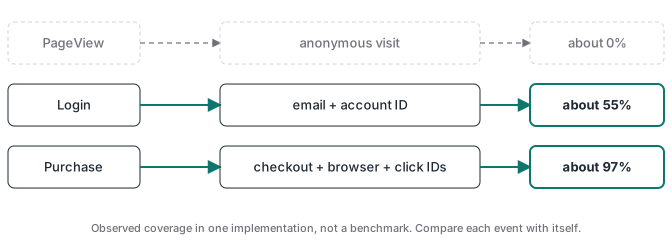
Identifier coverage follows the customer journey. At PageView, the person may be anonymous. The request can still carry browser context, client IP address, user agent, and sometimes fbp, but it cannot honestly include an email or account ID that the visitor has not supplied. At Login, the site can associate the event with a known account, so email and external_id may become available. At Purchase, checkout often supplies email, phone, name, address, and an order-linked customer ID. The browser record may add fbp, plus fbc when a Meta ad click started the visit. That is why one implementation can show close to 0% coverage for a top-funnel field set, about 55% at Login, and around 97% at Purchase without being contradictory. Each percentage describes a different event population and a different point of collection.
Those numbers are a field example, not targets to copy. Your funnel may collect email at account creation, postpone phone until fulfillment, or let guests purchase without logging in. Judge each event against its own data contract:
| Event | What may legitimately exist | What usually does not exist yet |
|---|---|---|
PageView | fbp, client IP, user agent, fbc after a Meta ad click | Email, phone, stable customer ID for an anonymous visitor |
Login | Email, external_id, browser context | Checkout-only phone or address fields |
Purchase | Checkout identifiers, external_id, browser context, ad click reference when applicable | Any field the customer never supplied |
The ceiling is set at collection. A server container can normalize, hash, and route a field more reliably, but it cannot create an identifier that did not exist. The Meta CAPI with GTM guide covers that routing layer and its deduplication setup.
Why should fbc appear only on Meta ad traffic?
fbc represents a Meta click reference. It comes from a real Meta ad click identifier captured on the landing page and preserved for the later conversion. A customer journey with no captured Meta ad click has no legitimate Meta click reference, whether the visit came directly, through organic search, from an email, or from another advertising platform. Its event should not carry a fabricated fbc. A returning visitor may still carry a valid reference saved from an earlier Meta ad click, which is why the history of the journey matters more than the current referrer. When Events Manager reports low fbc coverage across all Purchase events, the denominator can make a healthy setup look incomplete because only the Meta-ad subset was eligible in the first place. Measure capture among landing sessions that actually arrived with the click identifier, then check whether those values survived until the server event.
This is where hosted checkouts often break the chain. The landing page sees the click, but the payment webhook arrives later with no browser URL or cookie context. The first-party click ID index shows how to store that browser record before redirecting and retrieve it after the payment is confirmed. The purpose is accurate attribution for eligible traffic, not filling every fbc row in the dashboard.
Why can an 8.0 to 9.3 score move without a setup change?
A stable implementation does not receive an identical population every day. The mix shifts among paid and organic traffic, anonymous and logged-in visitors, guest and account checkouts, new browsers, returning customers, consent states, and devices. Each group arrives with a different set of identifiers. On a low-volume event, a small batch of guest purchases can change the displayed score more than it would on a high-volume event. Meta recalculates the diagnostic from received events, but it does not publish enough detail about the display window and weighting to treat a decimal change as a release monitor.
An oscillation between 8.0 and 9.3 can therefore be normal when nothing changed in the container. Check the underlying parameter coverage and event mix before opening a bug. If email, external_id, fbp, and eligible fbc coverage remain in their expected ranges, and Purchase still reconciles with the payment system, the movement is not evidence of a broken deployment. Record releases separately. EMQ is too aggregated to replace versioned request inspection.
When is the recommended update warning just noise?
The warning is noise when it asks a top-funnel event for information that does not exist yet. An anonymous PageView cannot send an accurate email before the visitor types one, creates an account, or completes a checkout. The platform recommendation sees a missing parameter. It does not see your form stage, the visitor’s consent choice, or the conversion-rate cost of adding another field. Treat the prompt as a question about availability, not an instruction to collect more data. If the site already knows the email at that moment and the event is permitted to use it, trace why it is missing. If the visitor is still anonymous, the empty field is correct.
There are two bad ways to silence the warning. One is scraping a value from an autofilled form before submission. The other is adding phone or address fields only to improve EMQ. Both change the collection surface for a dashboard score. The practical move is to send identifiers at the first legitimate event where they exist, such as Login, Lead, or Purchase, and leave the earlier event honest.
What should you fix when EMQ is genuinely low?
Fix expected data that is lost between collection and delivery. Choose the conversion event that matters, define which identifiers should exist there, and trace one real request through every hop. The Meta server event parameter reference is the contract for event fields; the customer information reference is the contract for matching fields. A green HTTP response only proves that a payload was accepted. It does not prove that the values were populated from the correct person or request.
Use this order:
- Pick one event and one recent deployment version.
- Write down the expected identifiers for that event stage and consent state.
- Run a controlled interaction from the real traffic path you want to test.
- Inspect the value at collection, in the web request, inside the server container, and in the outgoing CAPI payload.
- Correct empty mappings, unstable
external_idvalues, normalization errors, wrong hashing, and proxy IP or user-agent substitution. - For
fbc, test a real eligible ad-click path and verify persistence to the conversion. Do not use all traffic as the denominator. - Publish one identifiable change, wait for enough new events, and compare the same event again.
A managed first-party host such as Stape can keep the server container available and simplify the delivery path. It does not fill empty parameters. The collection and mapping still have to be correct. Stape is an ATA partner used in professional implementations, and the code MRPV20 gives 20% off the first three months.
What still needs testing after the score looks good?
A high EMQ score can belong to a bad conversion. Meta may match a duplicated Purchase perfectly, match a thank-you page load that came from a failed payment, or match an internal test order with excellent customer data. Test delivery, deduplication, and truth separately. Browser Pixel and server CAPI copies need the same event name and event ID when they describe one action. Purchase counts need to reconcile with approved transactions. Consent has to reach both browser and server paths. The payment processor or CRM remains the source of truth for whether the action happened. The server and browser event receipts show how to turn those counts into a recovery audit.
That separation is the operating principle behind Advanced Tracking Academy. The ATA Meta CAPI container gives media buyers and agencies a pre-built client and server setup with deduplication and webhook validation, plus the walkthrough for tracing a real event end to end. Build the event correctly, prove it happened once, then use EMQ to improve how well Meta can match it. The score belongs near the end of that sequence, not at the beginning.