
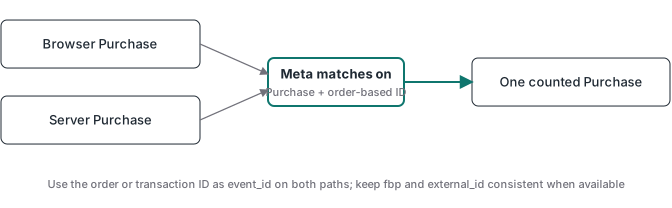
Meta CAPI deduplication works best when a browser Purchase and its server copy carry the same event_name and the same event_id. For purchases, Meta’s own server event reference says an order number or transaction ID can be used as that event_id. The browser sends it as eventID; the Conversions API sends the identical value as event_id. Meta can then recognize two delivery routes for one order and keep one counted event.
That is more precise than saying “add an event ID.” A random UUID is valid, but it becomes useless when the browser invents one value and the payment webhook invents another. An order-based identifier is already attached to the financial fact you need to reconcile. Pair it with fbp and a stable external_id when those values legitimately exist. You get deterministic deduplication, browser context, and stronger customer matching without asking one field to do three jobs.
This guide continues the Meta Conversions API with server-side GTM setup. That article covers the full route from Pixel to a server container. Here, we stay on the part that causes the most misleading alerts: Purchase identity, the 48-hour processing window, and the difference between two received copies and two counted conversions.
How does Meta CAPI deduplication work?
Meta receives a browser event from the Pixel and a server event from the Conversions API. For the standard identifier approach, it compares the browser event plus eventID with the server event_name plus event_id, all under the same Pixel ID. A matching pair received within the documented 48-hour window can be treated as one customer action. Meta says it generally prefers the event received first when the two copies do not differ meaningfully. The delivery order is secondary. Identity is the deciding input. The identifier can be any unique string shared by both routes, but Purchase already has a better candidate than a disposable random value: the order or transaction number that appears in your payment records. Use it consistently and the same value can be inspected from the browser call through the webhook and final CAPI request.
For a purchase, the pair should look like this:
| Route | Event name | Deduplication identifier | Other useful identity |
|---|---|---|---|
| Browser Pixel | Purchase |
eventID = order_8472 |
fbp, and external_id when available |
| Server CAPI | Purchase |
event_id = order_8472 |
The same fbp and external_id when available |
| Result | Same action | One shared value | One counted Purchase after processing |
The spelling matters. Pixel uses eventID in the fourth argument of the fbq call. CAPI uses event_id in the server payload. The values must match character for character. Meta’s deduplication documentation describes both the identifier method and the alternate fbp or external_id method.
Should an order ID or transaction ID be the event_id?
Use an order number or transaction identifier as event_id when it identifies one real Purchase and can reach both routes. Meta’s server event parameter reference gives this exact example: two purchases with different order numbers need two different event IDs, and each browser Purchase must reuse the number sent by its matching server call. A random number is more appropriate for an event with no intrinsic identifier. There is a subtle naming trap here. CAPI also accepts order_id inside custom_data. That field is useful transaction detail, but the deduplication reference does not present it as an independent substitute for event_id. Put the order or transaction identifier in event_id for the browser-server pair. You may also include order_id as purchase data if your payload contract calls for it. One describes the transaction; the other gives Meta the identifier used to collapse the two delivery paths.
An order-based value also makes support work faster. You can take order 8472 from the payment ledger, locate the Pixel call, locate the webhook request, and compare the exact same string in both. A throwaway browser UUID often disappears at the checkout boundary. If your payment system creates the final transaction only after redirect, persist a pre-created checkout identifier and map it to the final order before the webhook fires. The hosted checkout click ID guide shows the same persistence pattern for browser context.
What do external_id and fbp add to deduplication?
fbp and external_id give Meta another documented way to recognize a browser-server pair when those values and event_name remain consistent. fbp identifies the browser instance created by the Pixel cookie. external_id is your stable first-party customer identifier. Meta can use either or both for automatic deduplication across the browser and server routes. In a Purchase implementation you control, send them beside a shared event_id, subject to consent and the data you actually collected. Matching is a different question. Meta needs to decide which account may be associated with the action, so accurate fbp, eligible fbc, hashed customer data, and a stable external_id improve the material available for that decision. A shared order-based event_id can deduplicate perfectly while customer matching remains weak. The Event Match Quality guide explains why identifier coverage changes by event type.
Do not generate a fake fbp or borrow an external_id from another person to fill a field. Send what belongs to this customer action. A clean payload often has all three: event_id for the action, fbp for the browser, and external_id for the known customer. They overlap as signals, but they remain separate identities.
There is one more boundary. Meta says two consecutive server events with the same fbp or external_id are not automatically discarded under that alternate browser-server approach. Your webhook receiver still needs idempotency. Store the payment notification ID and transaction ID before sending CAPI, then reject a retry that has already been processed.
Why can two real-time events be a false alarm?
A real-time test can show one browser receipt and one server receipt because Meta has received both routes. That is the raw material for deduplication. It does not prove the reporting layer will keep two conversions. Meta documents a receipt window of up to 48 hours from the first event with a given event_id, so an immediate screenshot can be premature. Confirm the pair first: same Pixel ID, same Purchase name, same order-based ID, and arrival inside that window. Then let processing settle and compare the consolidated count with approved orders. Waiting cannot repair a broken pair. Two different IDs remain two unique events. Two Pixel calls from a native integration and GTM are also a separate installation problem. A webhook replay needs server-side idempotency. These cases may look identical in the first minute, which is why time alone is a poor diagnostic.
Use a small evidence table for each controlled order:
| Check | Expected evidence | Failure meaning |
|---|---|---|
| Financial ledger | One approved transaction | Establishes how many purchases exist |
| Browser request | One Purchase, correct eventID |
Extra browser call means two owners are firing |
| Server request | One Purchase, matching event_id |
Different value prevents deterministic pairing |
| CAPI user data | Correct fbp and external_id when available |
Missing values reduce context and matching |
| Processed total | One Purchase after the receipt window | Two retained events indicate a real defect |
The distinction matters during incidents. Turning off the server route because a live view shows two arrivals can remove the route that recovers blocked browser events. Keeping a mismatched pair inflates the optimization signal. Inspect the identifiers before changing the setup.
How should you implement order-based deduplication in GTM?
Start with the source of the transaction. The payment system or commerce backend should issue one stable order identifier for each legitimate charge. Store it with the checkout record. The browser must receive that value before it sends Purchase, and the confirmed payment webhook must retrieve the same value before the server container sends CAPI. On a checkout you control, the backend can return the order ID to the confirmation page. A hosted checkout needs a persisted mapping created earlier, because its webhook arrives without your first-party cookie or page state. Keep the mapping until retries are no longer possible. This small data contract matters more than the choice of GTM variable: browser and server can only agree on an identifier that survives the trip across every route and retry.
Then implement the routes in this order:
- Define the financial event. Send
Purchaseonly after the payment state your business accepts as revenue. - Choose one identifier. Use the order or transaction ID, with a namespace if several stores can issue the same number.
- Pass it to the Pixel as
eventIDin the fourth argument of the browser call. - Match the event name too. Set
event_nametoPurchaseand send the same identifier to CAPI asevent_id. - Forward every legitimate browser and customer identifier collected for this action, including
fbpand a stableexternal_idwhen available. - Block retries upstream. Before CAPI runs, idempotency should stop a processed webhook from creating another server send.
- Run one controlled payment and one negative control with a deliberately changed ID in a test environment.
The positive test should show two received routes that consolidate. The negative control should remain separate, proving the identifier is doing real work. Finish by reconciling Meta against the payment ledger, because a successful API response proves receipt only. The Stripe conversion tracking walkthrough covers the payment-webhook side of this design.
If you run several client setups, the implementation burden is mostly repetition: persistence, field mapping, webhook checks, browser-to-server identity, and validation. It gets tedious. Advanced Tracking Academy for media buyers provides the server-side GTM containers and setup guidance Vini uses for these flows, while a managed first-party host such as Stape can run the container; the data contract and test still belong to the implementation.
What should you check before calling the duplicate fixed?
Use one approved order as the unit of proof. Record its order ID, browser eventID, server event_id, event names, timestamps, fbp, and external_id. Verify the two routes hit the same Pixel ID within 48 hours. Check the processed event view after Meta has had time to consolidate it, then compare the final Purchase count and revenue with the payment ledger for the same period. Repeat with a webhook retry. Your receiver should stop the second server send before it reaches Meta. Repeat with a second legitimate order. It needs a different event_id and must remain a separate Purchase. Those two controls prove both sides of the rule: copies collapse, real orders stay distinct. Save one complete payload from each route as release evidence for later audits and handoffs. Retest every live change.
Keep the full Meta CAPI with GTM guide beside this checklist when you build the route. Start there. Payment validation decides whether the Purchase was real, matching fields connect it to the right customer, and reconciliation tells you whether the final count agrees with money received; ATA’s containers package those layers into a repeatable client implementation, with the checks still visible so you can prove what happened.